The Little Falls Historical Society Museum
Little Falls Diamonds Collection
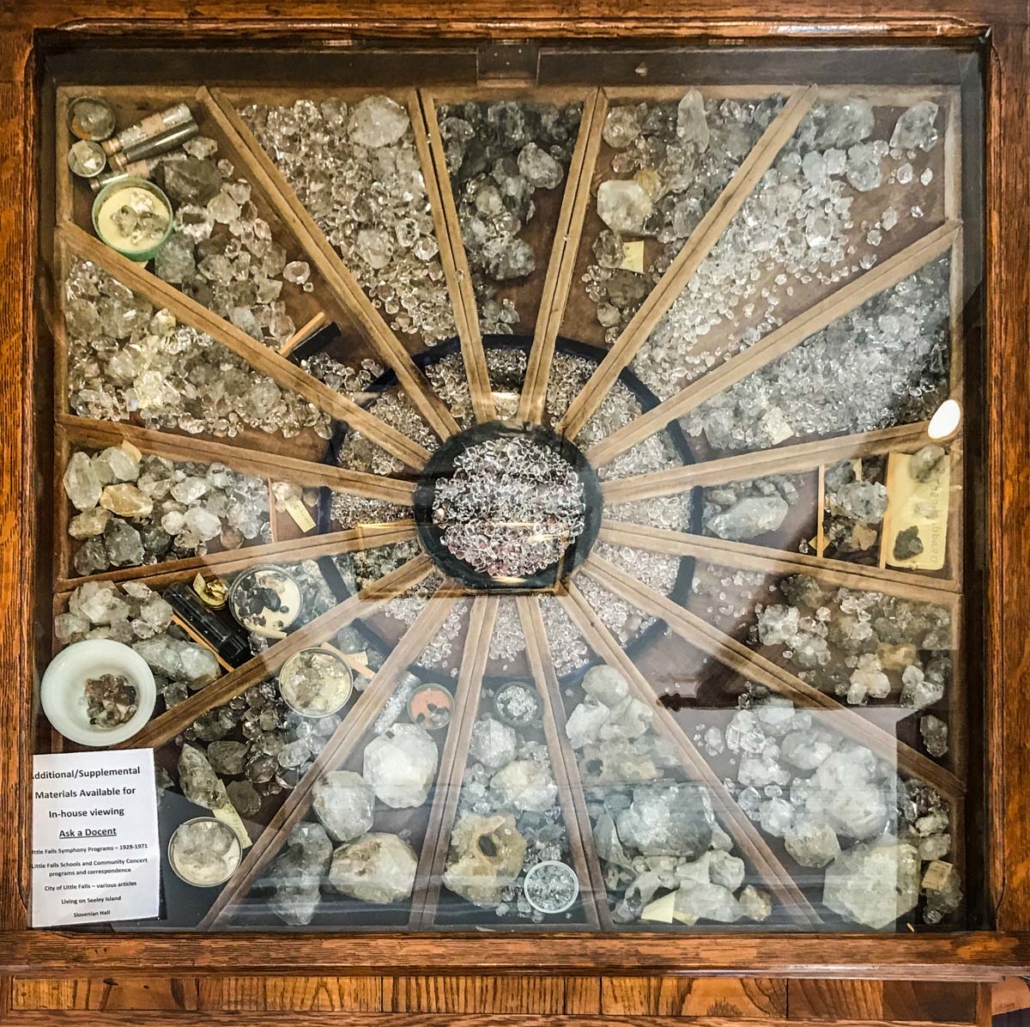
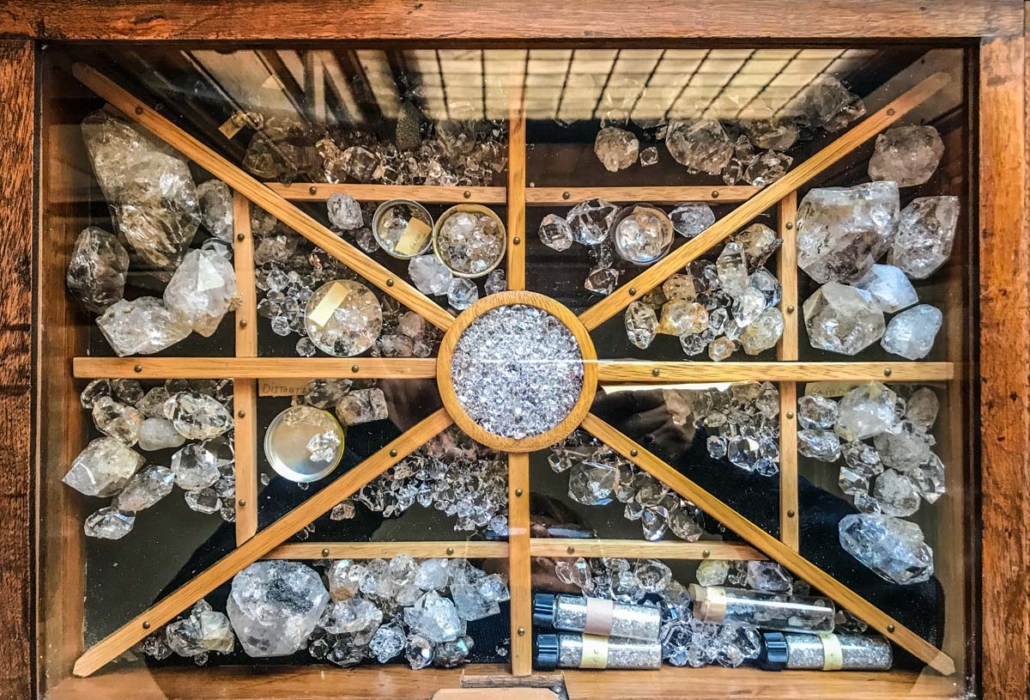
The Little Falls Diamonds Collection features many elaborate collections of Little Falls Diamonds found right in Little Falls.

by Don Hurley
This semi-precious stone is not a real diamond, which is pure carbon – but is a silicon dioxide, or sand and oxygen, the same composition as the glass in a window pane although much harder. The Little Falls “diamond” is a member of the great quartz family which includes opal, agate, fling, amethyst, and other branches either found massive, such as quartz rock from which mountains might be built; or having a definite shape which is signaled by the term “crystal.” When the quartz crystal is colorless and clear, it is called rock crystal. Thus, we identify the Little Falls “diamond” or rock crystal as a member of the great quartz family of minerals.
This rock formation was originally sediment laid down in the pre-Cambrian Little Falls Sea that covered much of central, northern and eastern New York State, millions and millions of years ago. The original limestone sediment was later altered in composition by a great natural disturbance and is now known as Little Falls Dolomite.
The rock crystal, or Little Falls “diamond,” was fashioned by nature in small pockets, or vugs, in this dolomite rock. The crystal is found by breaking open the rock which is often very hard; or it is free in the soil, having been weathered out of the rock matrix. Other minerals associated with and sometimes even included with the rock crystal are: calcite, dolomite, pyrite, and anthraxolite.
It is recognized for an unsurpassed perfection of form and sparkling brilliancy. In fact, the Little Falls diamond, or rock crystal, has been mistaken for the real diamond.
Even when found as a six-sided prism capped at each end by a six-sided pyramid forming a crystal of 18 faces, all glass smooth and sharp edged, it is difficult not to imagine such a stone has not, in truth, been artificially cut and polished. When our rock crystal is actually cut into such a brilliant gem it has a water clearness and lively sparkle that is beautiful even in terms of gemology.
Let the scientific define it as a rock crystal…we will always recognize it as a “Little Falls Diamond.”
What kind of stone is a Little Falls Diamond?
Quartz
What is a Quartz that is clear and colorless called?
Crystal
What is the natural pocket called that is found within a Dolomite Rock that holds the quartz?
Vug
How many faces (sides) does a Rock Crystal have?
18

 Native American Exhibit