The Little Falls Historical Society Museum

Distant Drums, Herkimer County in the War of the Rebellion

By David Krutz

In almost every corner of Herkimer County one can easily find reminders of the great impact that the Civil War had on the people of our area. In the center of Eastern Park in Little Falls the statue of a union soldier gazes across the valley, in front of the courthouse in Herkimer a memorial stone bears a plaque that pays tribute to the 34th New York, and in Dolgeville, Spofford and Faville Avenues recall the names of two hometown officers from the 97th New York.

Little Falls during the Civil War Era

LITTLE FALLS ANSWERS ABRAHAM LINCOLN’S CALL TO ARMS

“On April 15th [1861], two days after the surrender of Fort Sumter, President Lincoln issued a call for the Northern states to supply seventy-five thousand men to suppress the rebellion.  Reaction in Herkimer County to Lincoln’s call was immediate.

The largest of the Union rallies in Herkimer County was held in Little Falls on the afternoon of April 20th.  Organized by Little Falls militia officers, P.C. Petrie and Dr. John Sharer, a large number of citizens formed behind the Citizen’s Brass Band and marched to the Railroad Depot.  There the column was joined by a contingent from Herkimer headed by that village’s militia leaders James Suiter and Byron Laflin.  The parade continued but a short distance before stopping in front of the home of Zenas Priest, a prominent businessman and a Major in the Herkimer County militia.  Major Priest appeared on the balcony and read the latest war news hot off the telegraph wires.  The procession stepped off again and marched through the principal streets of the village, gathering up onlookers along the way, before dispersing to meet later that evening.

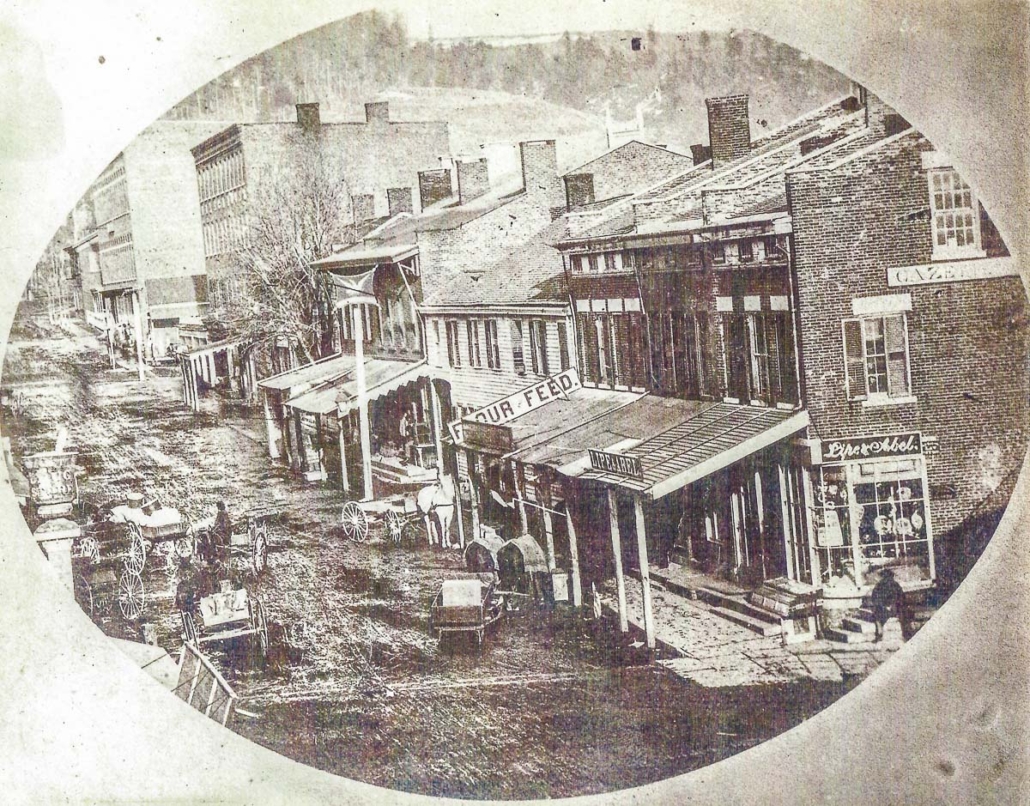
Main Street in Little Falls, 1863 – Corner of Main Street and Second Street, looking southeast. The flag in the center-left in the picture is a recruiting flag. Below the flag sits the recruiting sergeant.

By nine p.m. over one thousand people had gathered at Western Square [Burke Park].  Under the illumination of a large bonfire and innumerable torches, Major Priest was elected to conduct the rally.  Judges A.H. Laflin of Herkimer and George Hardin of Little Falls spoke and the loud cheering of the crowd frequently drowned out their words.  As was expected, at the conclusion of the speech-making a large number of men enlisted on the spot.  The meeting concluded with the appointment of a committee to obtain funds for the relief of the families of volunteers.”

Note:  Records show that during the course of the war 583 men from Little Falls served in the Union Army or Navy.  Each and every one of these men were volunteers.

The 34th New York, the “Herkimer County Regiment” at the Battle of Antietam The Herkimer County Journal October 2, 1862

Letter from Colonel James Suiter, 34th N.Y.

“The order to go into line of battle was given and at double quick the men got into line.  Over fences, stone walls and ditches we were rushed into the woods not an enemy in sight until I had gained a point twenty yards in rear of an old stone church [Dunker Church].  At this point I discovered them coming up the hill in strong force, when I ordered my men to fire, which they did pouring in a deadly and tremendous fire upon the Rebels, which they returned with equal force.  I had, for some reason, been detached from my brigade and placed on the extreme left of the line, without any support in my rear or on my left.  I now discovered that the enemy were moving a strong force to my left in columns ten or twelve deep.”

Letter from Sergeant William McLean, 34th N.Y.

“We fired two or three tremendous volleys, which thinned their ranks: but we in turn received quite as warm a fire as we were able to give, and being flanked and cross-fired upon, were obliged to fall back.  We did so at first, in good order, loading and firing as we could: but the advancing of the rebels and their deadly fire was at last too much for the famed 34th, as well as for many regiments, and we broke for a time and ran about thirty rods: then we rallied and turned upon the foe, who gave way before us. The action was short, not exceeding fifteen minutes, and our loss in killed, was 32 and wounded, 108.  All this was the fault of some one who led us into the face of the foe unsupported on the left.  We were within ten rods of the enemy when the first fire was opened, and before we fell back far, they came so close as to take ten prisoners, and others were wounded with gun-stocks, &c.  This we could call nothing better than outright slaughter, and the time and number of victims show it was nothing else.”

Painting of the 34th N.Y. and its division crossing the field towards the Dunker Church at Antietam. The 34th N.Y. is on the left flank of the first line.

Note:  The battle of Antietam was the bloodiest day in American history.  Six Little Falls men were killed at Antietam.  From the 34th N.Y – Privates William LaDew, Stephen Cool and Ralph Walby, and from the 97th N.Y., another regiment from the area – Private Daniel Horton, Corporal William Gray and Sergeant Roswell Clark.

In Camp near Mercersville, Md, with the 121st N.Y. (Herkimer/Otsego Counties) Letter to the Herkimer County Journal October 2, 1862

Lieutenant John Smith began the letter.

“We travelled from Fort Lincoln to here since two weeks ago and are as happy as clams.  Pete Emmel and L. H. Greenman are now cooking dinner and they sweat like the old Harry.  George Snell just came in camp with his dog that he ‘jayhawked’, and a rabbit which his dog caught.  We are going to have the latter for supper.  I wish that you could come in and see us devour the animale.”

Corporal George Snell continued the letter.

“We are stationed now in a small hollow, just east of a wood where the rebels were day before yesterday.  It is quite a pleasant place, but I am afraid we will leave tonight or in the morning.  We have good living here as a general thing.  I pity the goose, chicken or pig Company A gets a sight at.  You would laugh to see Charley Hammond and Bill Judd cut up the fresh meat and sail in on the provender.  Snell, Redway and Frank Burt are lying down here so lazy they can’t move, and big Joe Heath is putting some hard crackers down that big mouth of his.”

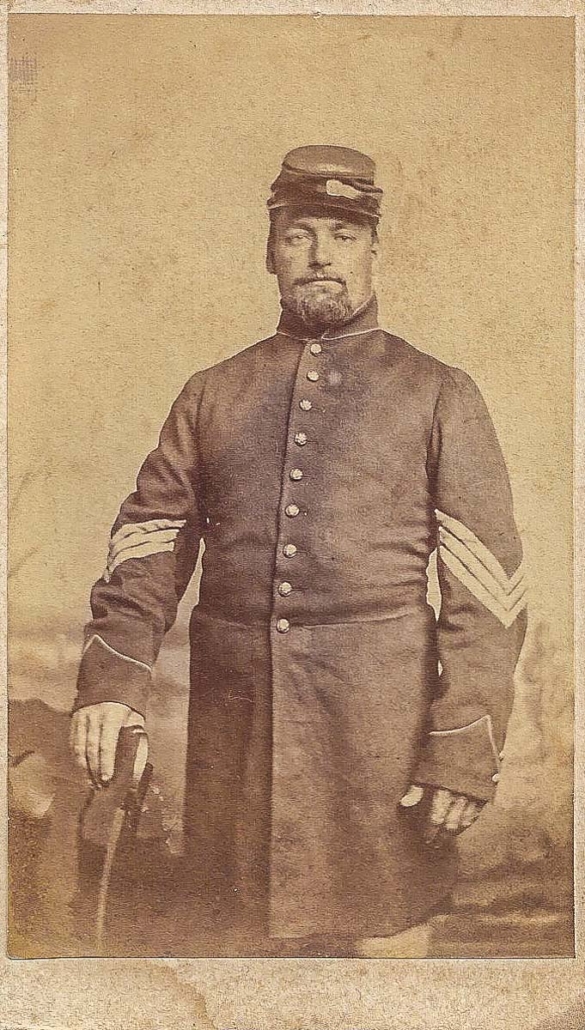
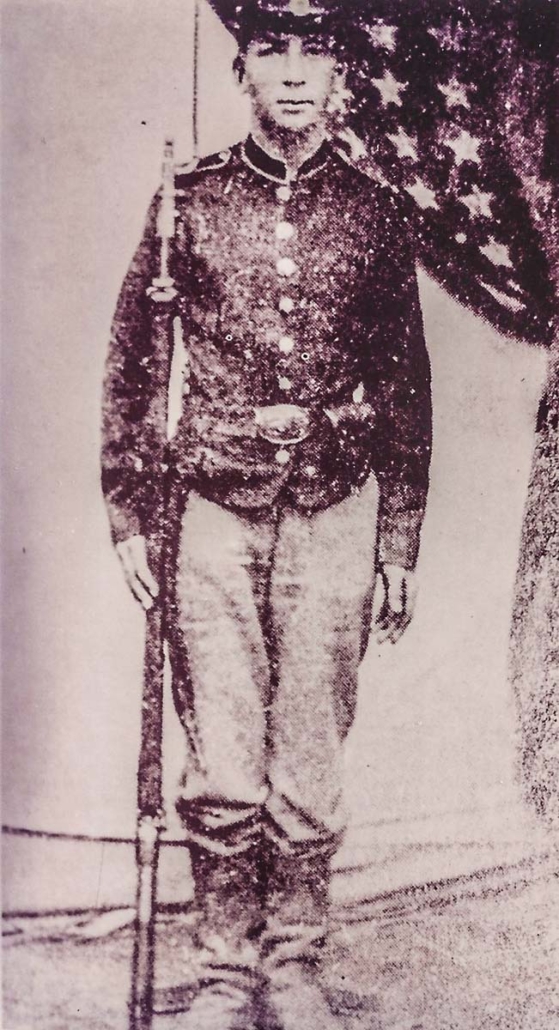
Sergeant Joe Heath of Little Falls

Sergeant Joe Heath of Little Falls.

Sergeant Joe Heath finished the letter.

“We started from Camp Lincoln, and moved from there beyond Georgetown and encamped for the night – and the dew fell thick enough that night, you may believe, for in the morning, when I aroused the boys for a march, our blankets were nearly wet through: but that is what makes us healthy and tough. But Stebb [Jean Stebbins, editor of the HCJ], what pulls on the boys are those long marches.  After marching from seven to twelve hours they begin to ‘loll’ and when we retire to our respective places we drop away into the land of nod in no time. We have lots of fun and are getting as fat as bucks: feel like bull dogs, fat, ragged and saucy.”

Note:  Joe Heath, Charley Hammond, Frank Burt, Sheldon Redway and Bill Judd were from Little Falls, Pete Emmel and George Snell were from Manheim, Lewis Greenman from Salisbury and John Smith from Mohawk

The 121st N.Y. at the battle of Salem Church, Va., May 3, 1863 Letter to the Herkimer County Journal, May 14, 1863

Letter from Captain Marcus Casler of Little Falls

“After firing two rounds our Regiment advanced into the road, when the Rebs in pits poured a volley into us, mowing us down like grass.  We held the road about fifteen minutes, when having fired nearly all our cartridges, we were ordered to fall-back, which we did in good order.  But on getting our Regiment in line again and looking, we found it only half as large as it was before the fight.

A great many of the Little Falls boys were wounded and all came from the field.  Captain Arnold was first wounded in the arm, but continued to cheer his men when he received another ball in his breast and fell.  Poor Wash Babcock received a wound in the abdomen, near the hip, the ball passing out near the spine.  I did not get a scratch, but the balls flew about my head as thick, that there would have been no use of dodging, if I had been so inclined.  One passed through my blanket, that is the nearest I came to being hit.  Our killed, wounded and missing amount to 273 – half our number.  It was a bloody and sorrowful baptism for us, but the Regiment did what was required of it honorably, and has the praises of the corps.  The Colonel’s horse was shot from under him, when he took the ground and fought like a perfect demon.  He don’t know what fear is.  Out of perhaps forty or fifty thousand bullets fired at us, only 273 took effect.”

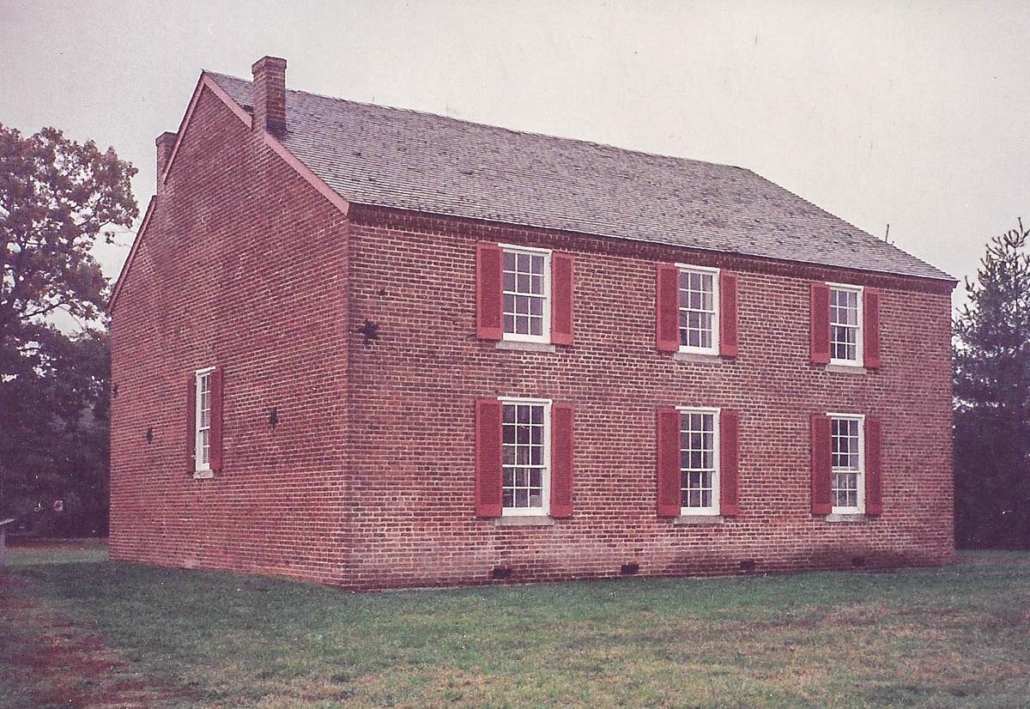
Salem Church

Salem Church

Note:  Of the approximately 550 men of the 121st that went into the battle at Salem Church 96 were killed and 180 that were wounded or taken prisoner. This percentage of casualties in the 121st N.Y. ranks as one of the bloodiest days for any Union regiment in the Civil War.  Eight Little Falls men – Thomas Arnold, Washington Babcock, John Brazamber, Orlando Casler, Michael Fagan, U.H. Harrington, John Maguire and Fred Staring – were mortally wounded at Salem Church.

The 34th N.Y. Comes Home.  Reception in Little Falls, June 13, 1863

“By sunup on Saturday morning, the roads leading into Little Falls were jammed with people.  Delegations from throughout Herkimer County came into town, aboard heavy farm wagons, in elegant carriages, on horseback and on foot.  Well-wishers from communities east and west of the village crammed special trains stopping at the depot.  Every stable and hitching post in town was appropriated as the crowd swelled to an estimated ten thousand people. The 34th New York and a contingent of escorts from Herkimer County left Albany for Little Falls aboard an early train.  Arriving in Little Falls at 11 a.m., the regiment was greeted by a deafening roar from the huge crowd that had gathered at the depot.  Cheer after cheer rent the air as the soldiers emerged from the cars.  The 34th’s officers tried their best to get their men into line, but the surge of the crowd made any formation impossible.  After a semblance of order was restored, Little Falls village president, M.W. Priest, formally welcomed the troops.

Following Priest’s address, a procession, headed by a squad of Little Falls police, formed on John Street.  The procession then headed east along John Street, up William Street and back westerly along Main Street.  Along the parade route, wreaths, banners and other decorations were hung on every storefront and residence.

Reaching Ward’s Square, the procession divided, forming ranks on both sides of the park, with only the men of the 34th being admitted to the center. On an elevated platform in the middle of the green, thirty-four young ladies dressed in white were arranged in a ‘pyramid of beauty.’  The crowd quieted as the girls, students of Miss Wright’s school, recited their welcoming tribute to the boys of the 34th. As the speech concluded each girl came forward and threw a bouquet of fresh spring flowers to the men of the 34th.

Afterwards the soldiers were conducted to a thousand-foot-long table, heaped with food.  The ‘eatables’ spread before them included: eight hundred pounds of meat, two hundred loaves of bread, one hundred and fifty pies, two hundred cakes, one hundred pounds of sugar, one hundred pounds of cheese, forty pounds of butter, pork and beans, pickles, radishes, oranges and tarts.  Over one hundred ladies waited on the soldiers, making sure that none of the men left the table hungry.

Wandering through the park after their meal, the men of the 34th were objects of the crowd’s adoration.  Men vigorously shook the soldiers’ hands, women kissed them and on many a cheek flowed tears of affection. At five o’clock those members of the regiment that had not drawn furloughs marched back to the train depot and loaded onto cars bound for Albany.  As the train departed, the crowd gave the men one last loud cheer.”

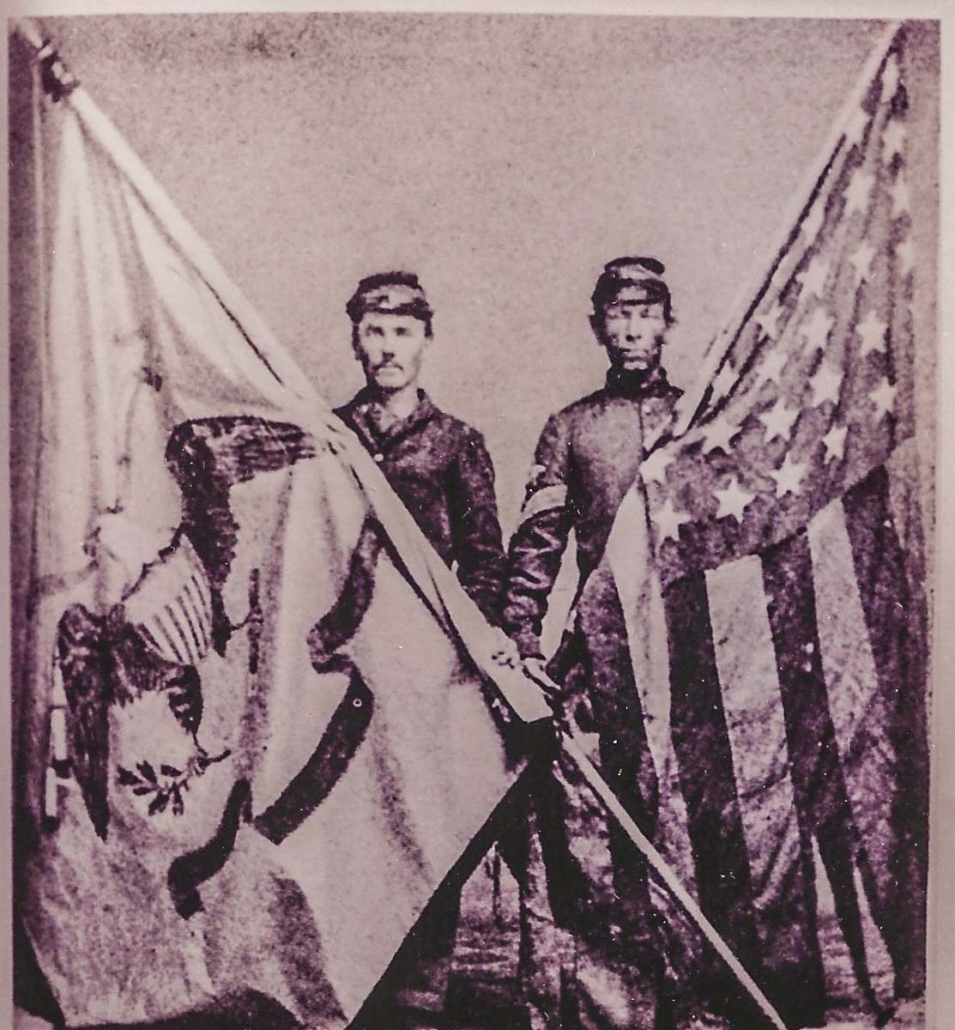
The National Colors and Regimental Flag of the 34th N.Y.

The National Colors and Regimental Flag of the 34th N.Y.

Note:  The 34th N.Y. was a two year regiment.  During its time in service 162 men died either from wounds or illness.  The regiment numbered 1100 men when it was mustered in on June 15, 1861.  On June 30, 1863 it mustered out only 496 men.
The 121st N.Y. Attack at Spotsylvania, Va. May 10, 1864

“Upton [Emory Upton, Colonel of the 121st N.Y.] formed his force into four rows, each three regiments wide.  At 6 p.m. the signal to charge was given and without firing a shot – the men had loaded but not capped their rifles – the blue spear flew at the rebel line.  Clinton Beckwith of Herkimer described the enlisted man’s side of the assault, writing:

‘It was nearly sundown when we were ready to go forward.  The day had been bright and it was warm, but the air felt damp, indicating rain.  The racket and smoke made by the skirmishers and batteries, made it look hazy about us, and we had to raise our voices to be heard.  We waited in suspense for some time.  Shortly after this the batteries stopped firing, and in a few minutes an officer rode along toward the right as fast as he could, and a moment afterward word was passed along to get ready, then ‘Fall in,’ and then ‘Forward.’  I felt my gorge rise, and my stomach and intestines shrink together in a knot, and a thousand things rushed through my mind.  I fully realized the terrible peril I was to encounter (gained from previous experience).  I looked about in the faces of the boys around me, and they told the tale of expected death.  Pulling my cap down over my eyes, I stepped out, the extreme man on the left of the regiment, except Sergeant Edwards and Adjutant Morse who was on foot.  In a few seconds we passed the skirmish line and moved more rapidly, the officers shouting ‘Forward’ and breaking into a run immediately after we got into the field a short distance.  As soon as we began to run the men, unmindful of, or forgetting orders, commenced to yell, and in a few steps farther the rifle pits were dotted with puffs of smoke, and men began to fall rapidly. We were broken up some getting through the slashing and the abatis.  By this time the Rebels were beginning to fire the second time, and a rapid but scattering fire ran along the works which we reached in another instant.  One of our officers in front of us jumped on the top log and shouted, ‘Come on, men’ and pitched forward and disappeared, shot.  I followed an instant after and the men swarmed upon, and over the works on each side of me.’

Private Clinton Beckwith of Herkimer

Private Clinton Beckwith of Herkimer

“Upton’s plan had worked perfectly.  The fast moving Union column had punched a hole in the Confederate works, and although the first line had suffered severely, the succeeding waves overwhelmed the defenders and driven them back two hundred yards.  Spreading out on either side of the breech, Upton’s men held their ground, but their supporting division never came (one rumor had it that the general in charge of the division was drunk).  Under a murderous fire from rebel reinforcements that hurried to the break, the Federal boys had to retreat.”

Note:  Among the men killed at Spotsylvania and the preceding fight in the Wilderness were James Monk, Levi Sherry and Samuel Tubbs.  General Ulysses Grant promoted Upton to a brigadier-general for his well-planned and gallant attack at Spotsylvania.  Beckwith’s description of the charge was published in the regimental history of the 121st N.Y.

Abraham Lincoln 

Rabbit

Battle of Antietam

No one came to relieve them.

Her bed.

Summer 1863 in Little Falls

“In Herkimer County the ideal weather of the summer of 1863 was in direct contrast to the cold, snowy, and overcast spring.  Warm, sunny days, combined with just the right amount of rain at exactly the right time, furnished growing conditions that every farmer and gardener could only have dreamt of.  Huge strawberries were gathered by the bushel, new potatoes were dug before June was out and the fields of green corn were chest-high by the 4th of July.

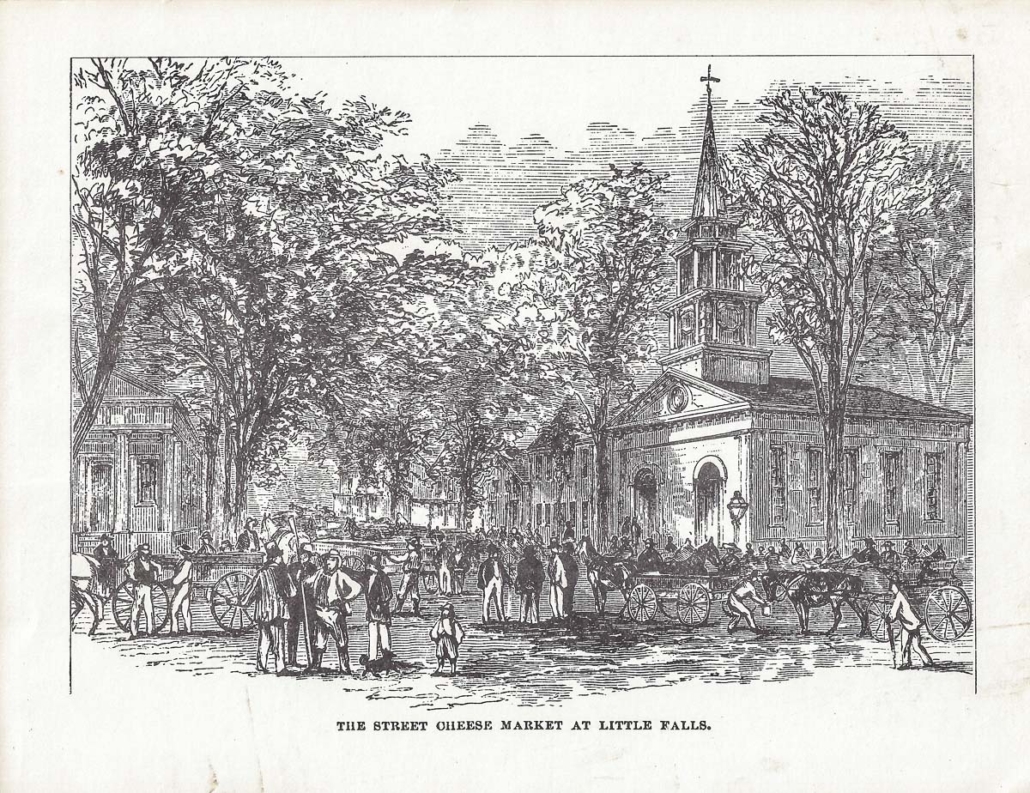
Dairy cattle fattened in lush pastures and consequently milk production increased dramatically.  With so much excess milk available cheese makers worked overtime.  On July 27th the train depot in Little Falls was inundated with a record two hundred and sixty thousand pounds of cheese.  From before sunrise to well after dark on that day, the streets leading to the depot and freight house were jammed with teams and wagons trying to unload their wheels of cheese.  A few wagoneers were obliged to spend the night in Little Falls, closely guarding their cheese until it could be unloaded the next day.

Also prospering in the fields and pastures during this most perfect of summers, were the horses of Herkimer County.  Surplus animals attracted Captain Fuller, an agent of the Quartermaster Department, who was looking to procure horse flesh for the U.S. Army.  Scouring the countryside, Fuller purchased almost seven hundred horses during July and August and shipped them to Washington via the Little Falls train depot.

As with any other summer there were outdoor activities much less strenuous and much more enjoyable than the toil of a farmer’s field. For the fisherman, Herkimer County’s streams, ponds, lakes and the Mohawk River abounded with pike, perch, bass and the favorite of sportsmen, brook trout.

For the bird hunter, a quarry much easier to catch and much more profitable than the elusive brook trout arrived.  Beginning in late May, immense flocks of passenger pigeons descended on ancestral nesting sites in the woods around Salisbury and Stratford and farther east along the Sacandaga River.

Almost before the birds could alight, teams of pigeon hunters armed with poles and large snare nets went to work collecting birds.  Within a day, an experienced ‘hunter’ could easily fill many bushels with the carcasses of these rather docile birds.  Packed in barrels of ice, at thirty dozen birds per barrel, this delicacy would bring $1.50 per dozen in New York City markets.  In June alone, over fifty barrels of passenger pigeons were shipped from the Little Falls depot.”

Cheese day in Little Falls. Corner of Ann Street and Albany Street.

Cheese day in Little Falls. Corner of Ann Street and Albany Street.

The Little Falls Flood of March 16, 1865

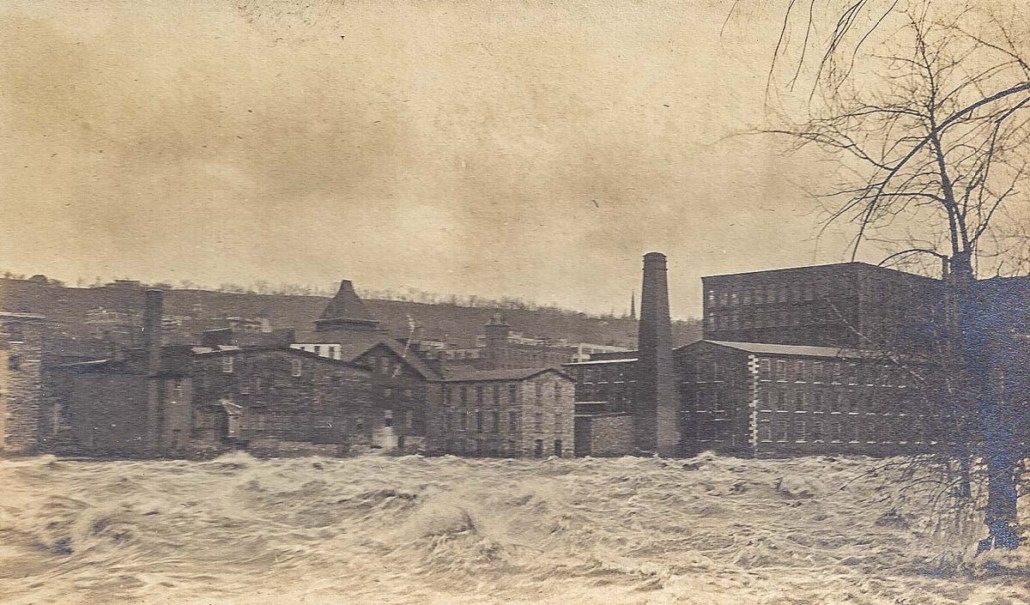
“In the early part of March, the winter long cold spell broke and the weather turned unseasonably warm and mild.  The great heaps of snow began to melt and heavy rains struck the valley towards the middle of the month.  The still frozen ground could not absorb this water and the resulting runoff cascaded down innumerable small creeks and rivulets into a rapidly rising ice covered Mohawk River.  On the night of March 16th, the ice broke on the swollen river and a flood of immense volume and power surged through the Mohawk Valley.  The ‘freshet’, complemented by ‘ice logs’ and timber, tore down small bridges in Frankfort and Ilion and the large West Canada Creek bridge in Herkimer.  A major break in the canal occurred near Mohawk and the Farmer’s Club building between Herkimer and Little Falls was swept away.  But the flood’s devastation was not fully realized until the torrent hit Little Falls.

The flood tide, which at its crest covered the upper span of the stone bridge at the foot of Ann Street, wreaked havoc with the mills at the river’s edge in Little Falls.  The southwest corner of Ligneon’s Paper Mill, just recently purchased by the Mohawk Mill, was entirely torn out and brand new machinery, some of which was still in crates, was washed away.  Farnam’s axe shop was carried off, as were several tenement houses and offices.  One of these buildings floated down the river in perfect condition only to be smashed to kindling against the stone bridge.  The stone bridge itself stood fast but acted as a perfect dam for the ice floes and lumber.  For a considerable distance behind this dam, the waters rose and inundated buildings well back from the river.

Spring Flood on the Mohawk River.

Spring Flood on the Mohawk River.

Two miles east of Little Falls, the roaring waters, now laden with all sorts of debris, blasted through the Fink’s Basin area.  The Fink’s Bridge, which had been constructed less than a year before at a cost of $9,000, was completely swept off its piers.  All of the homes adjacent to the Mohawk near the bridge were flooded to such an extent that the inhabitants could only be saved by boatmen who braved, not only the raging water, but also a blinding snowstorm that had sprung up.  One of the rescued Fink’s Basin residents was old Mrs. Van Etten, who had been confined to her bed for a number of years by consumption.  Mrs. Van Etten, whose condition was such that her physician forbade even mopping floors while she was in a room, was pulled from her floating bed by men in a skiff and carried in a chair to Little Falls.”

Note:  The only loss of life from the flood was that of a horse owned by Mr. Fink.  Damages in Little Falls alone amounted to $130,000 or over $4,000,000 in 2021 money.

Richmond Falls – Celebration in Little Falls Herkimer County Journal April 13, 1865

“The reception of the glorious news of Monday morning threw our village into a perfect fervor of excitement.  Everybody shook hands, smiled, laughed, hurrahed and was happy.  A ‘Band of Freemen’ from Mill St. with sticks and wooden guns, gave swift chase after every citizen as he appeared from his house, and amid the shouts and laughter of a great crowd, conducted him with mock ceremony, to an improvised Provost Marshals’ office where he was expected to ‘take the oath of allegiance’ – a glass of ale, a cigar, a shake of hands all around as he might prefer.  For two hours or more this fun went on, each new-comer swelling the crowd and laughing heartily at the sight of his successors under similar chase, arrest and pilotage to the grand rendezvous.

About ten o’clock the band appeared and a laughing procession formed and paraded till noon the principal streets, with cheers and uninterrupted hilarity.

Around noon a large procession of cart teams with vehicles filled with men and boys had a similar parade.  The places of business were closed and everybody was out upon the streets each congratulating his neighbor and all ‘Merry as a marriage bell.’

About half past seven o’clock the torch-light procession formed on Main St. and thence marched through nearly every principal street of the village.  Along the entire distance Roman candles were fired from the procession and from many of the houses: reports of cannon were echoed from hill to hill and small arms and fire-crackers resounded from knots of boys at every corner.  The Stars and Stripes were everywhere spread to the breeze, were unfurled from windows by ladies’ hands, were waved by boys and girls along the streets and were carried on tops of umbrellas.  No. 2 Fire Company appeared on horse-back, the others on foot in the procession.

The houses of nearly all our citizens were very brilliantly illuminated with Chinese lanterns, transparencies, &c. and the effect of the entire celebration was most pleasing and satisfactory.

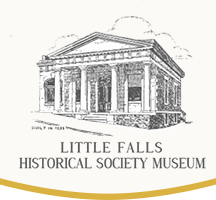
Reunion of the 'boys' of the 121st N.Y. in Little Falls, 1912.

Reunion of the ‘boys’ of the 121st N.Y. in Little Falls, 1912.

As soon as the exercises were concluded, the Band appeared upon the roof of the Journal & Courier office [on Main Street] whence were let off a large number of rockets, wheels and other fireworks.”

Note:  During the four years of war 70 men from Little Falls died; either from wounds, disease or in Confederate POW camps.