The Little Falls Historical Society Museum

Myjava, Slovakia, Sister City of Little Falls

In the late 1800s, economic conditions were dire in the Austro-Hungarian Empire, where present day Slovakia was located. Production of handmade goods had significantly declined and manufacturing jobs were scarce. The only option left for many people, especially the younger generation, was to return to farming or immigrate to the new “promised land” called America.

Myjava, Slovakia Writing Series

Click on the author and title below to read the writing series articles.

Anna Mocko

Because they Mohawk Valley felt like home & work could be found in the local factories.

SouthSide : Filnt Ave & Jefferson St

The Little Falls Textile Strike of 1912

YMCA

Family roots of Myjava

Commemorates our connecting partnership with another country 

Marek Dolezaj

It all started with a mistake. One of the first to leave Myjava, a small village of 10,000 people, was young Anna Mocko, who left for America in 1892 and settled on a farm near Minneapolis, Minnesota. Three years later, she decided to visit friends in Little Falls, New Jersey. The railroad agent in Minnesota mistook the “J” for a “Y” on her handwritten ticket, and sent Anna on her way to Little Falls, New York. It seems the “J” and “Y” is used interchangeably in Slovak.

Departing from the train in the right village but in the wrong state, Anna was puzzled when no one was there to meet her, and this coupled with the language barrier presented a major problem. Fortunately, Anna was befriended by the Little Falls ticket agent, George Boyle, who spoke a little German. Boyle was able to find a place for her to stay. Little Falls was about the same size as Myjava. Manufacturing jobs were plentiful and Anna quickly found employment in the mills. She also noticed that the hills and valleys surrounding her new home were delightfully similar to those around Myjava. She wrote glowing reports to her friends and relatives back home, and soon a few left for a new life in the new world and Little Falls.

(Read the rest of the article below.)

LITTLE FALLS — In the late 1800s, economic conditions were dire in the Austro-Hungarian Empire, where present day Slovakia was located. Production of handmade goods had significantly declined and manufacturing jobs were scarce. The only option left for many people, especially the younger generation, was to return to farming or immigrate to the new “promised land” called America.

It all started with a mistake. One of the first to leave Myjava, a small village of 10,000 people, was young Anna Mocko, who left for America in 1892 and settled on a farm near Minneapolis, Minnesota. Three years later, she decided to visit friends in Little Falls, New Jersey. The railroad agent in Minnesota mistook the “J” for a “Y” on her handwritten ticket, and sent Anna on her way to Little Falls, New York. It seems the “J” and “Y” is used interchangeably in Slovak.

Departing from the train in the right village but in the wrong state, Anna was puzzled when no one was there to meet her, and this coupled with the language barrier presented a major problem. Fortunately, Anna was befriended by the Little Falls ticket agent, George Boyle, who spoke a little German. Boyle was able to find a place for her to stay. Little Falls was about the same size as Myjava. Manufacturing jobs were plentiful and Anna quickly found employment in the mills. She also noticed that the hills and valleys surrounding her new home were delightfully similar to those around Myjava. She wrote glowing reports to her friends and relatives back home, and soon a few left for a new life in the new world and Little Falls.

First a trickle, and then a flood of people left the Myjava region. Although thousands of Slovaks left to be with relatives and friends in large cities like Pittsburgh, Minneapolis, Cleveland, Chicago and New York City, the most important center for people from the Myjava region was the small town of Little Falls, New York! In fact, Little Falls was frequently called “Myjava in America” or the “Second Myjava.” Nearly one thousand people made the move from Myjava to Little Falls.

Stories abound about the lives of the early immigrants. In one instance, one man planted his crops in Myjava during the spring season, crossed the ocean to Little Falls and worked in the factories during the summer months, and then returned to Myjava for the fall harvest. Life was not always rosy for the Slovaks in Little Falls. The language barrier presented a major problem and the immigrants had to quickly master English. In Europe, they had lived under totalitarian regimes and they did not understand living in a democracy. This new found freedom presented its own problems. Working conditions in the many knitting mills were poor. Most of the young girls and women found employment in the mills as did some of the men. Other men worked on the railroad, in machine shops and on farms. The work was hard, the hours long (60-hour work week), and the pay low (8 to 10 cents per hour.) In spite of all of these hardships, the new settlers were eventually able to support their families, buy their own homes (mostly on Flint Avenue and Jefferson Street), and even send money back to relatives in Myjava. Old world debts were paid off, land repurchased and major improvements made to their old church in Myjava in the form of a new silver cross and altar pictures.

The Little Falls Slovaks, at first, tended to keep together, that is a community within a community. In 1911, they built their own place of worship on the South Side at a cost of $19,275 — the Holy Trinity Lutheran Church. For years the services were in Slovak until 1937 when the first service in English was conducted. In 1996, the last Slovak language service was held. Three sons of the congregation have served in the ministry — Rev. John KIc, Rev. Andrew Brndjar and Rev. George Mocko, retired Bishop of Baltimore.

The Holy Trinity Cemetery sits on a hillside overlooking Little Falls and in it are buried many of the original immigrants from Myjava and their families — Babjar, Babuska, Bachorik, Brndjar, Buno, Chegren, DIhy, Dudik, Ferjanec, Gasper, Gavac, Greeny, Hmirak, Holick, Holovitz, Ivan, Juras, KIch, Klimacek, Klimek, Konenik, Krchniak, Krupa, Kuboviak, Lenarcic, Lizenbold, Majtan, Maytan, Michalec, Miko, Mizerak, Mocko, Mucica, Nemcek, Osley, Paracka, Prestopnik, Prochazka, Rohacek, Sadlon, Siegal, Sivak, Skandera, Slezak, Stefula, Stransky, Swancera, Talaba, Valach, Valo, Vanek, Vdoviak, Viskup, Vtabel, Walach, Zeman and Zemcik.

The Slovaks also formed social clubs (Slovak Protestant Union), groups for cultural and sports activities (Union of Physical Culture Sokol) and had their own newspaper and library at the Sokol Hall on Flint Avenue. The young gymnasts at the Sokol Hall were well renowned throughout the Mohawk Valley for their physical exercise skills. During this same time period, immigrants from various other eastern European countries arrived in Little Falls. They came from Italy, Poland, Hungary, Slovenia and Austria, but certainly not in large numbers from any one small locality. They too lived on the South Side.

In time, the various immigrant groups began to interface with each other especially in the factories, and in 1912 they banded together against management in the famous Little Falls Textile Strike.The newly opened YMCA (1916) offered a place for the youth of the community to play together and forge common bonds irrespective of national origin. As assimilation progressed and the ethnic groups intermarried, national identities began to blur. Within a generation or two, the descendants of the initial Slovak immigrants were assimilated. Many of the sons and grandsons of the first Slovak immigrants returned to Europe during World War I and World War II to fight against the countries of their parents’ birth. Some lost their lives.

Little Falls would be a much different place today if that unknown ticket agent in Minneapolis had made a “J” instead of a “Y.” The Slovaks came and made a great impact on our community.

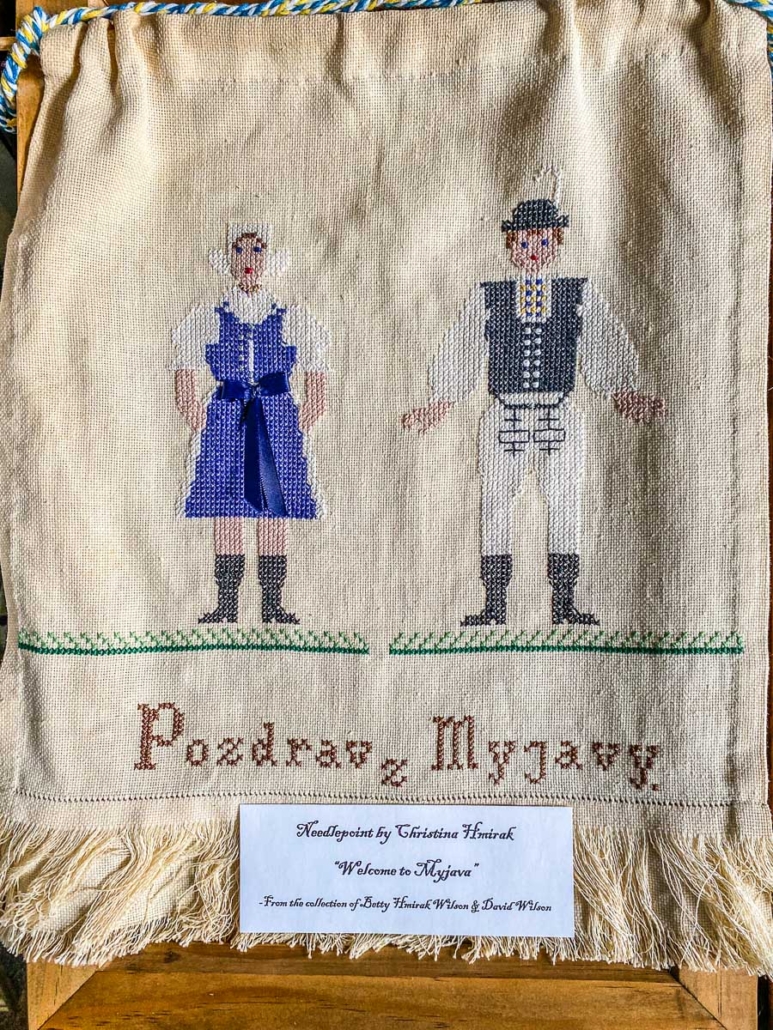
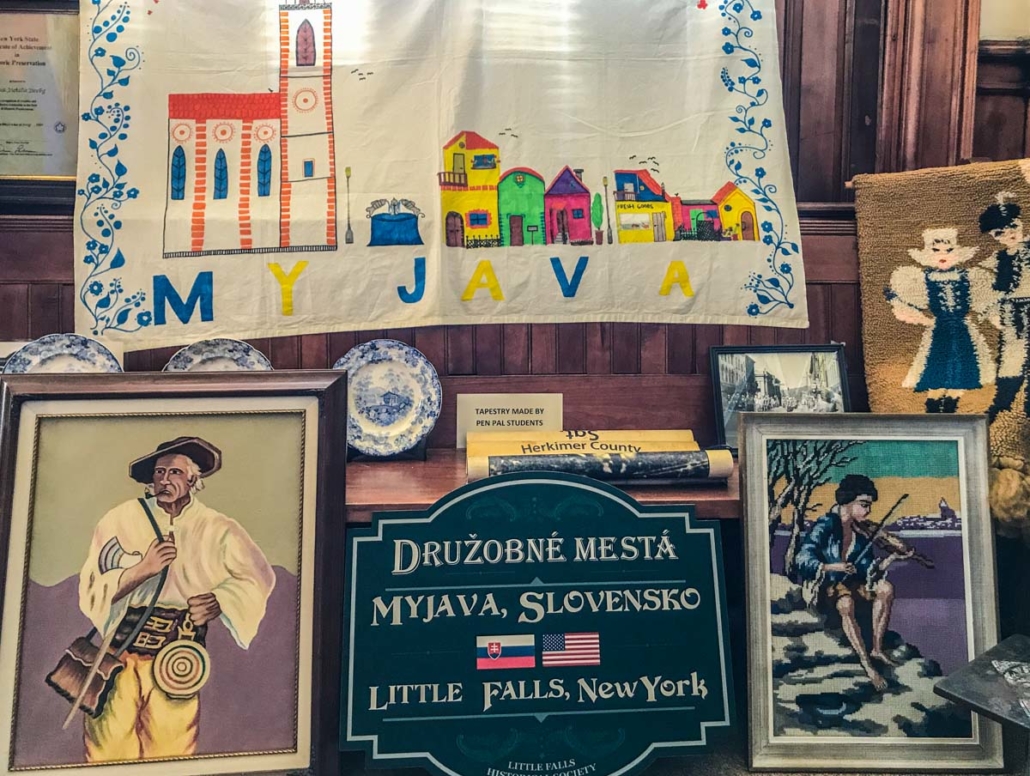
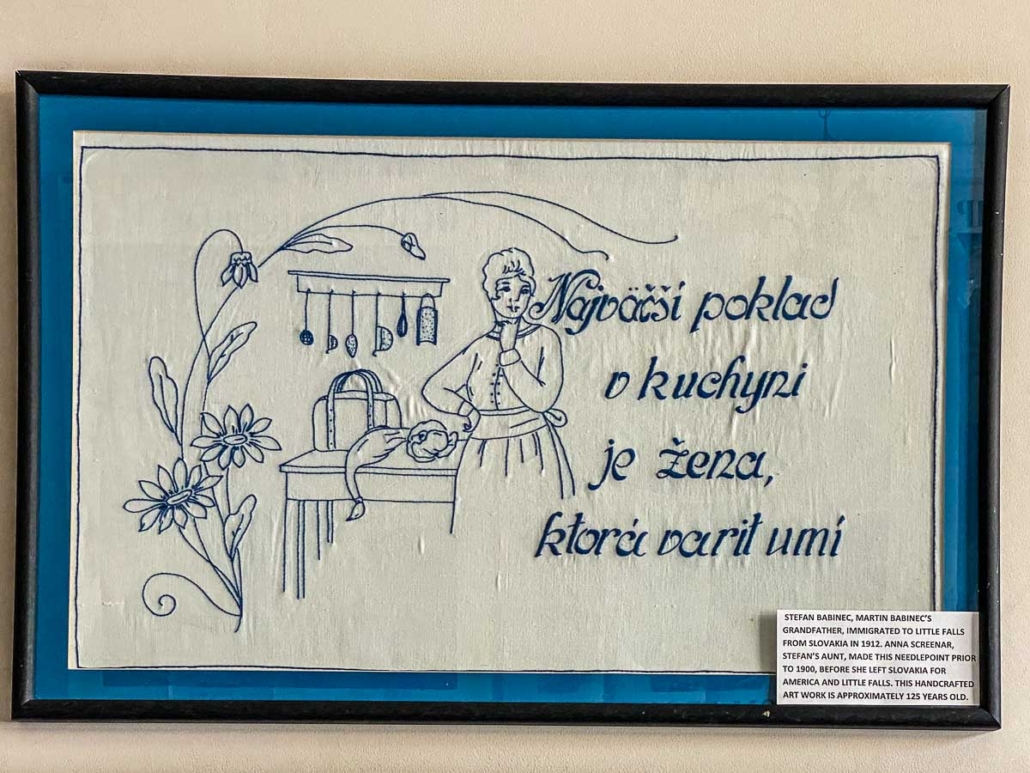
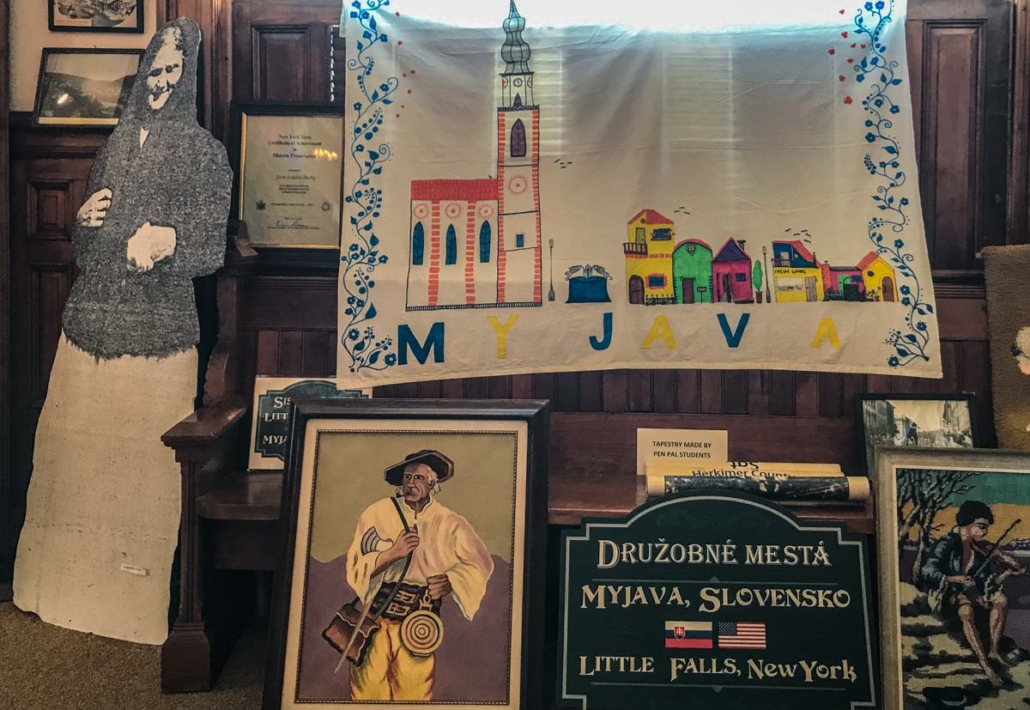
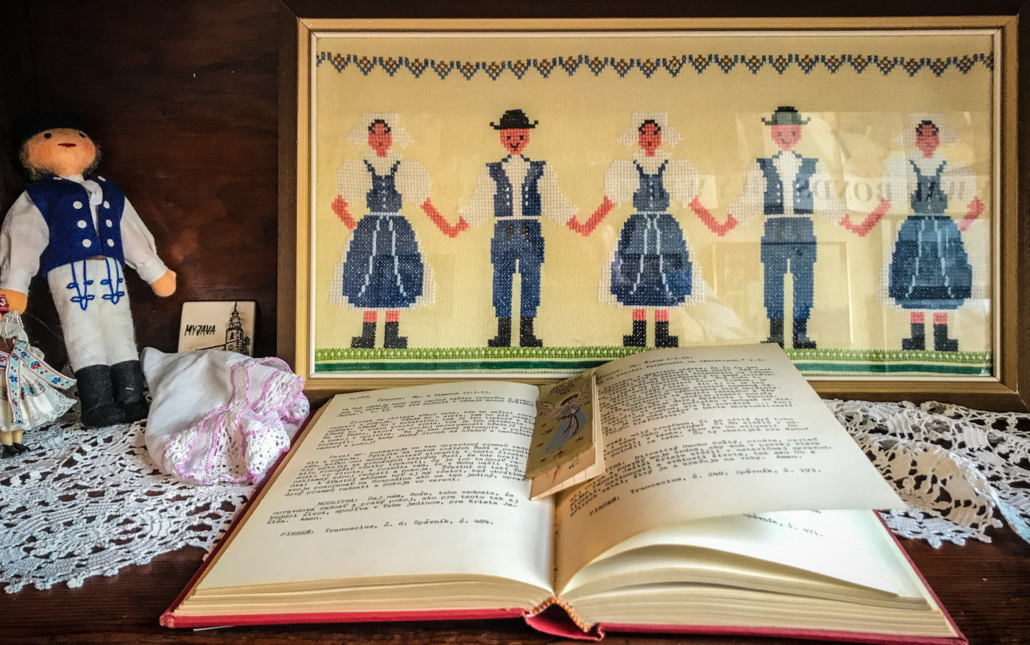
To commemorate this seminal event in our history, the Little Falls Historical Society has arranged an exhibit at its museum concerning Myjava, Slovakia, and its relationship to Little Falls. A formal association was formed in 2014 when then Mayor Robert Peters of Little Falls and Mayor Pavel Halibran of Myjava signed proclamations joining the two communities as “sister cities.”
LITTLE FALLS —The story of the new green signs that have popped up around Little Falls is a tale of two cities, sister cities that is. This is a story told in three parts; beginning in the late-1800s with the immigration of around one thousand Slovaks, from the Myjava region of Slovakia, to Little Falls, the creation of the United States Sister City program by President Dwight D Eisenhower in 1956 and ending with the placement of these signs.

The immigration of Slovaks to Little Falls began with one single immigrant. The young Anna Mocko arrived in the United States from the Myjava region in 1892, beginning her new life on a farm in Minnesota. A few years after starting her new American life Anna set off on a train to visit friends in Little Falls, New Jersey. One slight miscommunication later and Anna discovered herself to be in Little Falls, New York. Fortunately, Anna found a friend in the Little Falls Ticket Agent, George Boyle, who spoke enough German to find Anna a place to stay. At the time, Little Falls was about the same size as Myjava and with similar surrounding hills and valleys it was not hard for Anna to feel at home in the community.

With such a positive experience in her newfound residence, Anna wrote affirmative letters to her friends and relatives in Myjava encouraging them to follow her example and start new world lives in Little Falls. Slowly at first, then aggressively, Slovaks left the Myjava region with their sights set on America. Although many Slovak immigrants created homes for themselves in large cities across the United States, the most dense population joined Anna in Little Falls, New York. In fact, so many joined her that Little Falls began being referred to as “Myjava in America,” solidifying the bond between the two communities.

Over time, the Slovaks adapted to life in Little Falls. Fighting through the language and cultural barriers that came with moving to a new country, many found factory jobs. However, they did not just come to America to work, but to continue their lives. As the population of Little Falls grew so did the number of intermarriages between Slovaks and people of other ethnic groups in the community. Although only a thousand Slovaks moved to Little Falls in the late-1800s to the early-1900s, they quickly assimilated, creating homes, families and a unique culture. So much so that many current residents of Little Falls can still trace their family lines to this first wave of immigrants, and ultimately, Myjava.

Thanks to Anna Mocko, Myjava, Slovakia and Little Falls, New York, will be forever bonded. But how do we truly commemorate this connection? Thankfully, there is a way. In 1956, in post-World War II America, President Eisenhower held a White House conference on citizen diplomacy. His enthusiasm towards creating a free and peaceful world for all sparked the support of tens-of thousands of Americans. The result was People-to-People International, an organization the world desperately needed as a nightlight amidst the fog of the Cold War. This society exists as the foundation of Sister City International, which became its own independent organization in 1967.

According to its Wikipedia page, Sister City International is a nonprofit citizen diplomacy network that creates and strengthens partnerships between communities in the United States and those in other countries. Many families in Little Falls have always been aware of their personal connections to Myjava, Slovakia, but it was not until 2014 that it was made official. Peter Adasek, as a representative of the Little Falls Historical Society, travelled to Slovakia and met with the Myjava mayor to obtain the documents, which were then hand carried to former Mayor Robert Peters. Through the official efforts of Peters, current Mayor Mark Blask, and the Little Falls Historical Society, Sister City status was officially established in 2014. Mayor Blask was happy to aid this process in any way he could and is thrilled that the city finally has a way to make its Slovakian pride public.

“The sister city signs around Little Falls look fantastic; we have received several compliments already on the one in front of City Hall. Many thanks to the historical society for spearheading this effort,” said Blask.

Little Falls is not alone in commemorating this connection; the next time you are in Myjava you can visit the Little Falls exhibit in their local museum.

Thanks to the generous funding by Little Falls resident and Myjava descendant Martin Babinec and the support of the Little Falls Historical Society, in July of this year the city of Little Falls found a way to publicly showcase this unique connection. New dark green signs boldly displaying “Sister Cities Little Falls, NY Myjava, Slovakia” joined by the national flags of both countries can be found at five entry points to the city and in front of City Hall.

“It is a thrill for me to see the Sister City relationship come together,” said Babinec. “Signs are now up in both Little Falls and Myjava as a visible reminder to all on the important connection between our two communities.”

Enter Little Falls from any direction and be reminded not only of our past, but of our bright future, and most importantly, this tale of two sister cities.

For more information on this sister city connection, visit the Sister City Exhibit in the Little Falls Historical Society. Open Monday through Friday, 1 to 4 p.m. and Saturdays 9 a.m. to noon.

LITTLE FALLS — Ahoj (hello) Marek!

And so began the recent “real time” dialog between 12 Little Falls seventh-grade students and Syracuse University basketball player and native Slovakian Marek Dolezaj.

Little Falls Middle School Students

Twelve Little Falls Middle School students pose with Little Falls Historical Society Slovakian artifacts during a recent Google Video Chat session with Syracuse University basketball player and Slovakian native Marek Dolezaj.

The students are participants in a Little Falls Historical Society and Little Falls City School District collaborative pen pal program. Two years ago, fifth-grade Benton Hall Academy students began corresponding with students in Myjava, Slovakia. The program is an outgrowth of the Sister City relationship between Myjava and Little Falls that began in 2014 as a way of recognizing that around 1,000 Slovakians from the Myjava region emigrated to Little Falls in the early 1900s seeking better lives. As the students transitioned to Little Falls Middle School, building principal Maria Lindsay helped to recruit teacher Susan Finkst to become the group’s adviser.

Finkst and the group of students meet regularly to work on pen pal letters with their counterparts in Myjava and recently they spent time preparing for the Google Video Chat session with Dolezaj. They had a list of prepared questions for the second year player which the smiling 6-foot 10-inch forward was glad to answer. He seemed to enjoy the opportunity to interact through social media with a group of admiring students and Syracuse fans.

Dolezaj hails from Bratislava, the capitol city of Slovakia, which is about an hour away from Myjava. He has visited and is familiar with Little Falls’ Sister City.

When asked what he likes to do when not playing basketball, attending classes or studying, Dolezaj responded, “Spending time with my girlfriend and playing video games.” A few minutes later the students spoke out in unison, “Pod’me oranzova!” (Let’s go Orange!) and “Vel’a stastia” (good luck).

The last question posed to Dolezaj concerned what advice he could give middle school students about the importance of working hard in school. He responded, “Working hard in school is very important and is the best pathway to becoming educated and getting a good job.”

The session ended with a thank you, “Dakujem Marek!,” to which he replied, “Prosim!” (You’re welcome).

The chat can be found on the Little Falls Middle School Facebook page at https://www.facebook.com/middlemounties.

The public is invited to visit the Little Falls Historical Society Museum in the old bank building at 319 S. Ann St. during the Christmas in Little Falls celebration on Saturday, Dec. 8, to view the Little Falls / Myjava exhibit, other exhibits and the museum’s Christmas decorations, including the handmade tree ornaments created and delivered by fourth-grade Benton Hall students during their traditional holiday visit to the museum.

Dolezaj left open the possibility of a future visit to Little Falls to meet up in person with the middle school students and visit the Sister City exhibit at the historical society museum.

This article was originally published in the Times Telegram on November 30, 2018.